High/Low Syndrome
High / Low syndrome is widely misunderstood so it ends up being widely mismanaged.
Almost every horse has it, even if it’s only a 1/2 degree difference. The origin of the issue is that the coffin bone angles are different because perfect symmetry isn’t common in nature. It can get worse over time if the bone is allowed to morph and erode from chronic toe loading. In my experience, the only sustainable remedy is to max out the soft tissue and live sole depth. The deeper the soft tissue and live sole develop, the more similar the angles get.
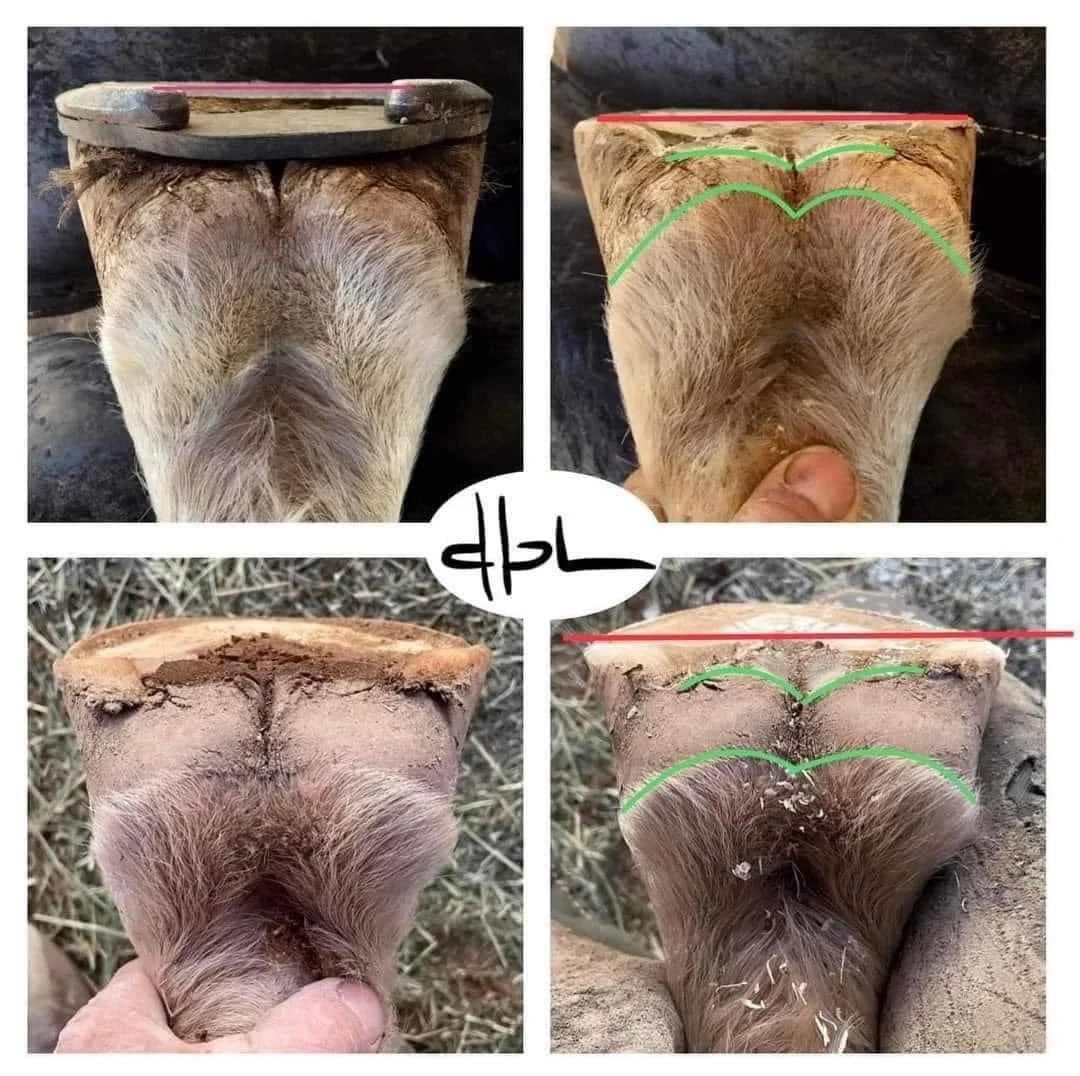
I don’t trim into calloused live sole to lower the heels and I don’t leave heel horn length to elevate the heels. I trim to build the space between the green lines. The result of this soft tissue development is retained dead sole exfoliation. That exposes more wall to trim. This keeps the rehab on the horse’s own personal timeline where corrections won’t be available until the DDFT and extensor tendon are ready for change.
Propping up the heels (with a wedge pad or heel horn height) only changes the immediate PA ( palmar angle, which is the angle of the bottom of P3 compared to the ground plane ) and immediate HPA ( hoof/pastern angle ). It may look like an instant improvement on a radiograph, but it doesn’t change the way P3 is cast in the hoof capsule. It takes 7 months of frequent proper trimming to grow a new hoof capsule and improve the P3/hoof capsule alignment, and 3-4 hoof capsules to achieve a fully live, undeviated hoof.
Pictured is two years progress after pulling steel shoes and a wedge pad on a horse starting with obvious high / low. This rehab had some challenging stages but his comfort has been continually improving.