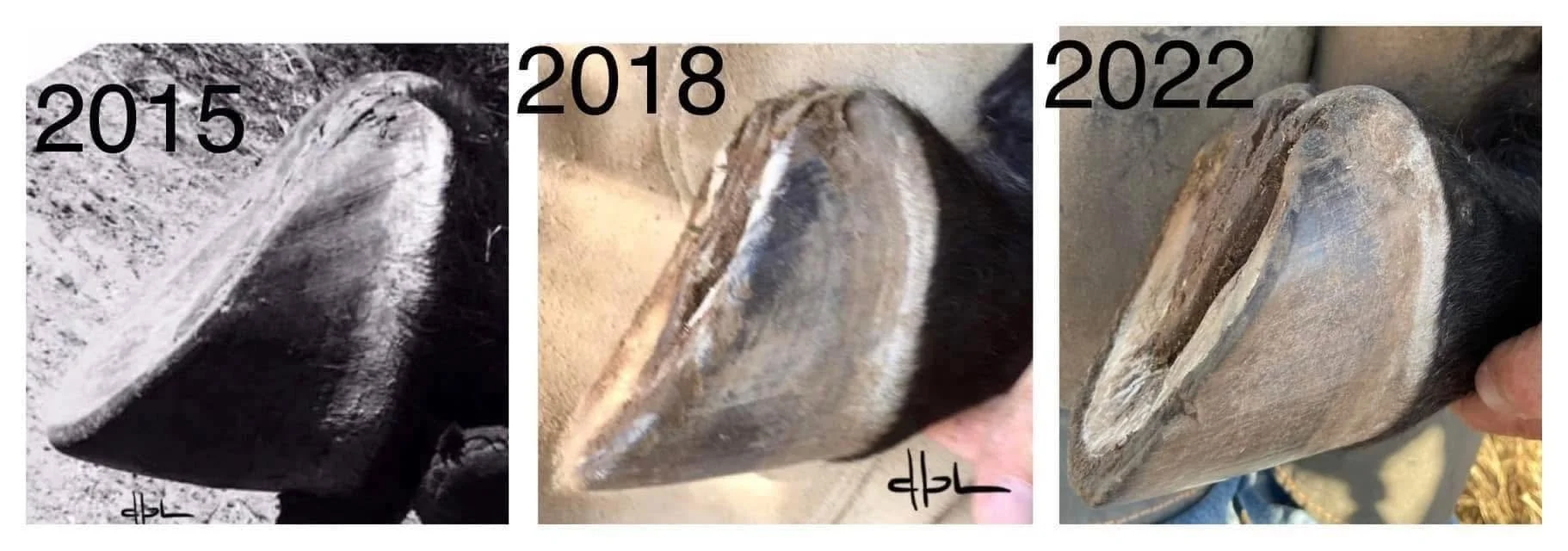
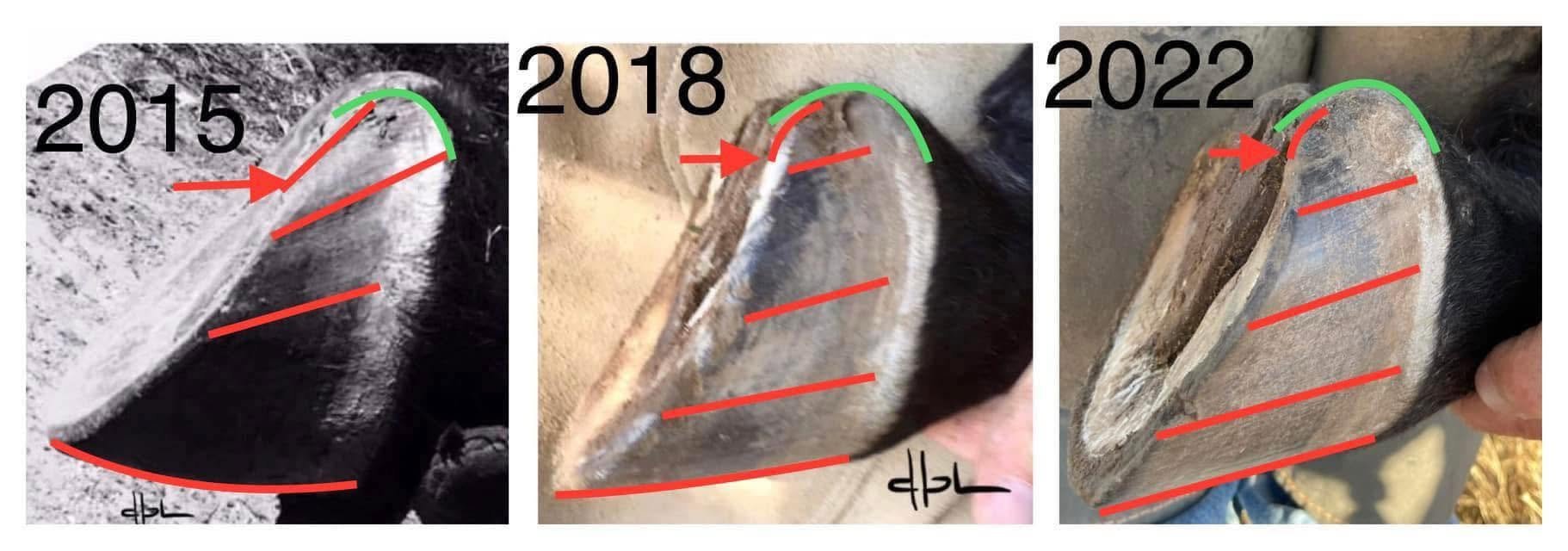
Sole Searching (Considering NPA)
NPA: Negative Palmar ( fronts ) or Plantar ( hinds ) Angle.
For all hooves, my main focus is on the frog/heels/seat of corn shapes and relationships, but I never consider a correction to the heels without considering a correction to the toe and vice versa. Hooves with negative angles often have a retained dead toe callous that is too thick, so they need to have that trimmed accurately to the level of the insensitive live sole, and the break over needs to be established at the edge of the insensitive live sole. At the back of the foot there is usually a thin layer of dead frog covering a thin atrophied live frog. The heels and bars are usually crushed under and ingrown into the frog and sole. This can make trimming very difficult.
In my opinion, the horse is still toe loading. This is counter intuitive so I get a lot of skepticism about that. The heels have just migrated too far forward and become part of the solar structures that get crushed from the horse leaning on their fore hand, away from a painful frog. I believe this is imperative to understand or you’ll just keep trying to prop up the heels on dead walls or wedges, which just makes matters worse.
Another thing that I believe, that is met with some skepticism, is that X-rays don’t help. The main problem isn’t the pedal bone having a negative angle. That is the symptom. The main problem is that the live sole is too thin and there is more retained dead sole thickness at the toe than at the heels. It isn’t easy to differentiate between sensitive live sole/insensitive live sole/and dead sole on an X-ray. Many vets and HCP’s just see “sole,” as the mass between the distal edge of P3 and the ground. It would be easy if you could just trim the “sole” off to balance the bone within the hoof capsule, but it doesn’t work that way, however, many vets and HCP’s follow this approach.
An even bigger problem is that the horn tubules in the hoof capsule will collapse and run forward against the grain of the pedal bone. The longer the hoof has been loading incorrectly, the more distortion there will be in the horn tubules. In order to restore this alignment, the weight distribution must be corrected. Just trimming toe and/or adding wedges changes the P3/ground relationship, but not the P3/hoof capsule relationship.
Retained dead sole accumulates when the hooves’ growth rate exceeds their wear rate. It compresses more wherever the horse leans the most. For example: a pigeon toed horse leans on their lateral toe pillars more, so the sole between the frog and the toe pillars will be more compacted and more difficult to trim off. Excessive lateral toe loading causes the live sole to get thinner and the dead sole to get thicker. Just trimming the sole off according to an X-ray to improve angles will expose the thin sole without correcting the excess weight bearing. When this technique is used the horse is more likely to need steel shoes with pads, or rubber boots, to keep them comfortable.
If you improve their weight distribution, they will build live sole thickness and exfoliate the dead sole because it is no longer needed. You’ll know it’s ready because it starts to separate from the insensitive live layers. It isn’t always easy to trim, but it is usually more obvious that it’s ready to be removed. It will take some experience to know the difference.
The way I remedy this situation is to frequently remove all the dead layers by simulating natural wear, without touching any of the live tissue. It’s very careful trimming and it should make it more comfortable for them to load their heels so they can build enough soft tissue and live sole depth to improve their angles. This can take 2-3 years of improving their comfort with every trim, for the angle changes to go from negative to flat to positive. So documentation is important for giving you the confidence to stay the course.