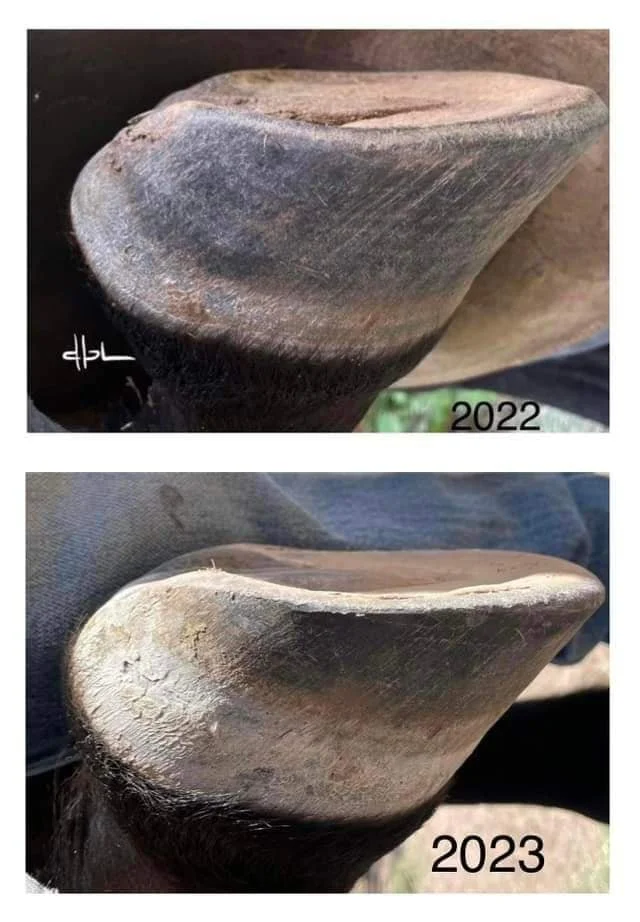
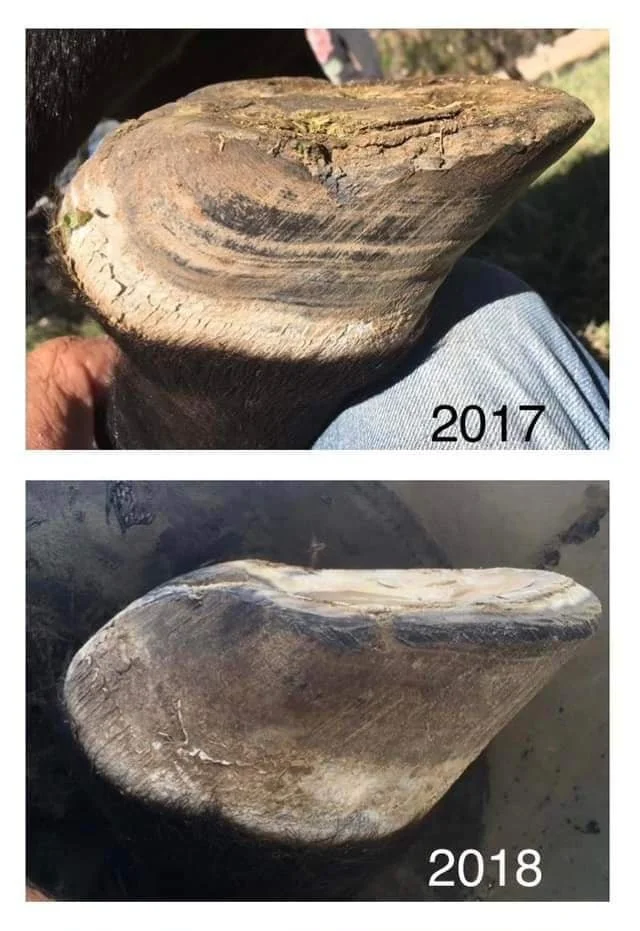
What is Laminitis?
I’ve been seeing a lot of posts on FB about what founder/laminitis is, what the pronounced growth rings mean, how it happens, and how to manage it. Another thing that I’ve noticed over the years is that a lot of people who attempt to publicly explain it don’t fully understand it. They’ve never fully rehabbed a horse. The answers are in the living horses. The ones that you can help continually improve. The problem is that these horses are typically in so much pain in the beginning that they can’t lift their legs long enough to give them a good trim. I’ve heard a lot of trimmers and farriers say, “it’s not worth my back.” At least they’re honest.
I have always said that diet, movement, and footing are important management practices, but “trimming your way out of the problem” is the only way to get over the initial stages in more extreme cases. It’s possible to get improvement if you have a lot of acreage or a track system with 3-4 inches of sand, but the horse may never reach FULL rehab status without frequent proper trimming. I just feel like I need to keep posting my thoughts and documentation for anyone who has similar goals for their horses…a full rehab.
After 18 years of fully rehabbing hundreds of horses with founder/laminitis my opinion is that it’s mostly caused by mechanical distortion. This makes it highly curable as well as preventable. If you know what to do.
All you have to do is keep the majority of the horse’s weight comfortably loaded over the back of their feet. This improves their posture and helps the horse grow in new hoof capsules that don’t deviate from their attachment to the coffin bone. Again, proper management including diet, movement, and footing are important factors, but none of these are likely to completely restore the P3/hoof capsule relationship and then max out the soft tissue depth in order to establish the true PA and HPA. That has to be restored by reversing the process that created the problem, which is chronic toe loading. This is mostly caused from improper trimming and/or neglect, and that typically comes from either ignorance or complacency. I’m not judging. I made mistakes in the beginning. I just learned from them. Turns out that guilt can be a good motivator…if you let it.
In my experience teaching in many locations with different climates and conditions around the world, there is one thing that every hoof problem has in common:
the shapes and relationship of the frog/heel/seat of corn aren’t correct ( specifically the sharpness of the insides of the heels and the amount of dead frog layers that are left on after a trim ). Some are way off and some are pretty close. In my experience, “pretty close” only prevents most of the distortion. That should explain why your horse’s feet only look “pretty good” and not perfect. Even though hoof care isn’t about beauty alone, the beauty comes from an undeviated hoof capsule where the growth rings are barely visible, and parallel to the hairline all the way to the ground and the horn tubules are also faint and parallel to the dorsal toe wall all the way to the heels. You can try to fake this by propping the heels up and/or rasping the flares off of the outside wall but this doesn’t change the way the hoof capsule is growing around P3. It just disguises the problem for a while, and makes it harder to fix in the future. This also doesn’t build soft tissue. It’s the development of the lateral cartilages and digital cushion that adds to the natural beauty of the foot. This is what gives the back of the foot the beautiful palmar contours. The longer it takes to recognize the actual problem, the harder it is to fix. I’ve met a lot of people that had this realization and told me that they had ignored a funny feeling that things weren’t quite right. This may be the real problem with hoof pathology…a lot of people have become more reliant on their brains ability to retain information and less reliant on their gut feelings. They are stuck some where in between, which causes some degree of paralysis.
This is what I think is responsible for horses not moving forward. You have to move forward…and then your horse will.
Starbuck is a TWH (former show hors ) that was saved from slaughter by one of my clients. After we collaborated for a few years on hoof and body rehabilitation, I became his owner. Now he lives in my herd. We started rehabbing him over the first few years on a 4 week trim schedule, occasionally going 6 weeks or more due to challenges with my schedule. For the past 2 years he’s been on a 2-4 week trim schedule. He has an album on my personal page. Starbuck was in light work shortly after the rehab process started and he was gradually ridden more as his comfort and hoof form steadily improved.