Reading the Sole to Determine the Stage of Development
Once you help a horse achieve growth/wear equilibrium by keeping the dead horn on the solar aspect of their hooves exfoliated ( simulating natural wear ) the distortion will grow out and the live hoof capsule will grow in evenly around the coffin bone without deviation. This can take years of frequent proper trimming so there are levels of rehab, as there are levels of development, and levels of damage that can make progress challenging. This is the opposite of trimming or shoeing to retain dead sole for immediate functional soundness ( keeping horses usable in-spite of their structural flaws ).
THIS DOES NOT MEAN THE HORSE IS LAME DURING REHAB. They should steadily improve with every trim. THIS DOES NOT MEAN THEY WILL. That’s where mindful experience comes in.
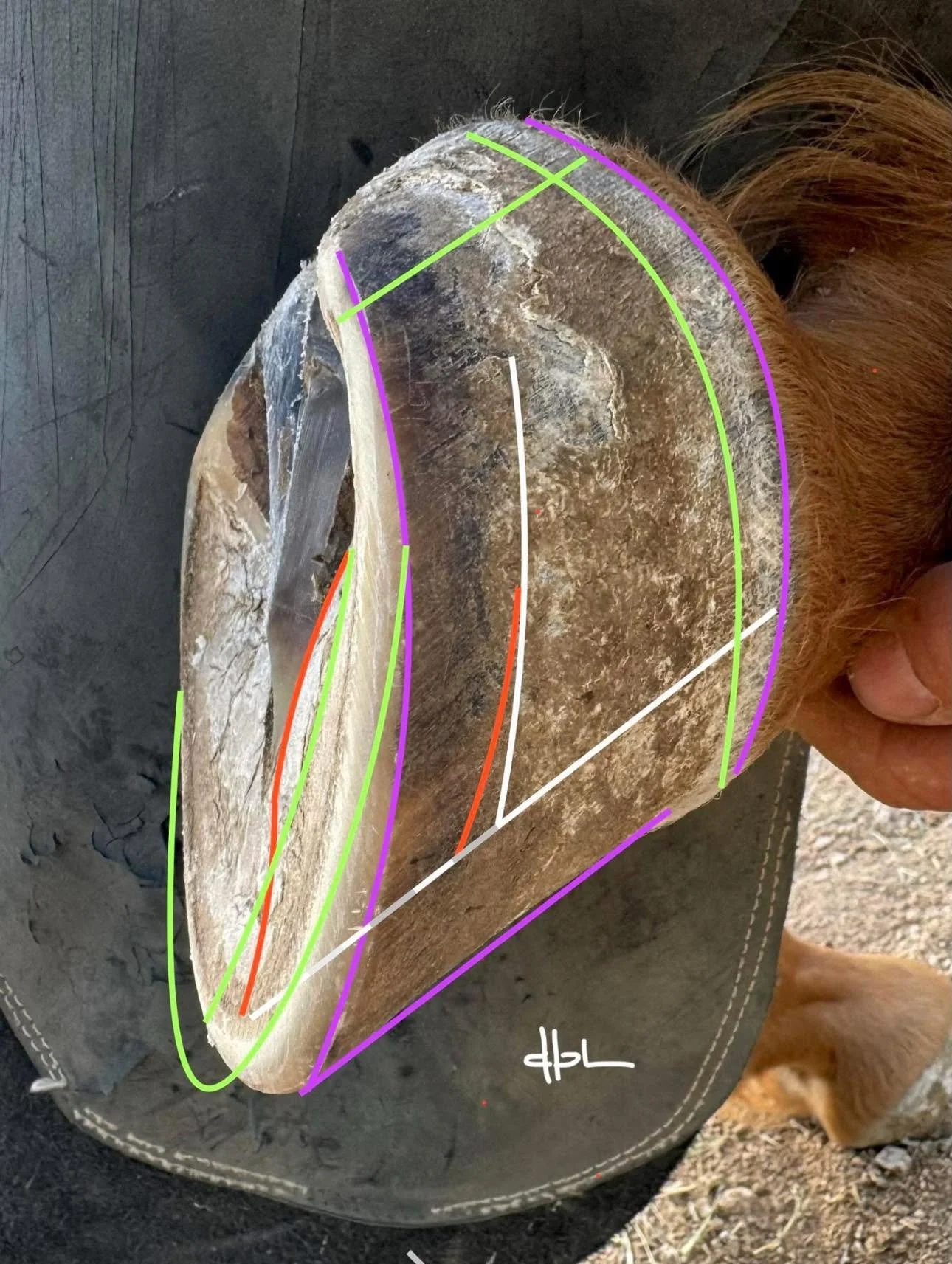
This is a fully live, undeviated hoof capsule that I’ve been rehabbing from pedal osteitis for 6 years. This horse was functionally sound before the rehab and has remained functionally sound. Functional soundness does not depend on structural soundness, however, in most cases, sustainable functional soundness does. This horse has significant high/low and his hooves were neglected until the age of 6. This is the higher angled hoof. I consider this a full rehab. This may be as far as this horse can go due to the amount of bone loss he has.
Some of the signs that indicate full rehab status ( besides functional soundness ) are:
-He is retaining minimal dead sole and the contour of his calloused live sole matches the contour of his coffin bone ( red lines show correlating bone and live sole loss and the reason I wrote this post in the first place ).
-A straight line can be drawn from the inside of the lamina to the extensor process that is parallel with the outer dorsal wall ( straight white and dotted line ).
-The horn tubules are parallel to the dorsal wall all the way to the heels. ( straight green lines )
-The hoof structures are tightly connected and have fluid transitions.
The curved purple lines show the current state of the coronary band/mustang roll relationship. The curved green lines show where they should be.
In my opinion, “full rehab” status doesn’t mean it can’t get any better. It’s like body building. There are limitations, but most people don’t reach them. That doesn’t mean you can’t live a healthy life. “Fully developed” is the term I use for reaching the limitations of a good foot. “As good as it gets“ maybe the term I use for reaching the limits of a more compromised hoof.
In my mind, these aren’t rigid categories. I still hang on to the possibilities of improvement in any case and I constantly question whether I’m missing something. I know that true growth/wear equilibrium for optimal development relies on the growth rate matching the wear rate step for step, and that takes roughly 20 miles per day on varied terrain to keep up with 1 mm of hoof capsule growth every 3 days. I’m just doing my best to get as close as I can to what Mother Nature intended. I try to have lofty goals with realistic expectations. That just means you can take the horse out of nature but you can’t take the nature out of the horse. So I try not to make excuses